
Traveling through the Yucatán Peninsula felt like much more than visiting historical landmarks — it was an opportunity to better understand a civilization that developed extraordinary knowledge of astronomy, mathematics, architecture, and spirituality.
This experience connected us not only with the ancient legacy of the Maya, but also with aspects of their living culture that continue to be present today. The itinerary combines nature, history, and cultural interaction in a way that feels balanced, comfortable, and meaningful.
Comfortable Journey into the Heart of Yucatán
Our day began with hotel pickup in Cancun aboard a modern, air-conditioned vehicle. The journey was smooth and relaxing, allowing everyone to enjoy the changing landscape as we traveled deeper into the Yucatán Peninsula.
The vehicle was clean, spacious, and very well maintained. Both the driver and the assistant supporting our guide were attentive and courteous throughout the experience, creating a welcoming atmosphere from the very beginning.
About halfway through the drive, our guide Gaby began introducing us to the worldview of the Maya civilization. She shared that her professional path started as a bilingual Spanish–Maya teacher in primary education. She even sang the Mexican National Anthem in the Maya language. After several years working in schools, she later became a certified cultural guide, allowing her to share her passion for Maya heritage with visitors from around the world.
Her explanations were engaging and easy to follow, supported by visual references of archaeological discoveries, symbolic representations, and interpretations that helped connect ancient knowledge with modern understanding.
Understanding the Maya Concept of Time
One of the most interesting topics Gaby explained during the journey was the Maya understanding of time.
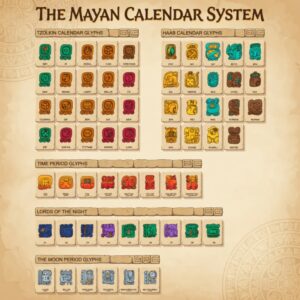
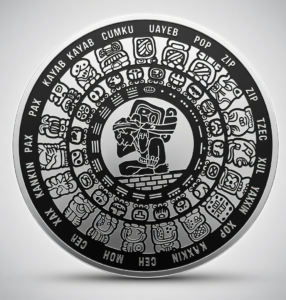
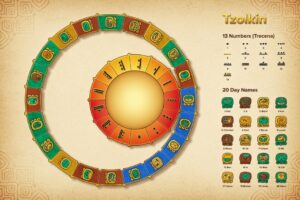
Rather than perceiving time as linear, the Maya viewed time as cyclical, guided by natural rhythms and cosmic movements. Their calendar system combined several cycles that allowed them to track solar patterns, agricultural seasons, and ceremonial dates with impressive precision.
Many symbolic representations of the Maya calendar include a central figure interpreted as “carrying time,” reflecting the belief that time itself is a living force that must remain in balance.
Gaby also explained how materials such as obsidian, a naturally occurring volcanic glass, were used to create tools, ceremonial objects, and reflective surfaces. Polished obsidian was sometimes associated with clarity and energy, showing how natural elements played an important role in Maya symbolism.
Mayan cultural experiences in Mexico
Arrival at Ki’ichpam Xunáan Cultural & Natural Park
Our first stop was Ki’ichpam Xunáan, a peaceful community space surrounded by nature. The name comes from the Maya language and expresses the idea of beauty understood as harmony between spirit, environment, and personal presence.
Gaby explained that in Maya tradition, beauty goes beyond physical appearance. It represents dignity, serenity, authenticity, and connection with the natural world.
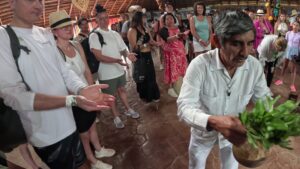
Upon arrival, we were welcomed by a Maya elder who performed a traditional blessing ceremony. He spoke in the Maya language while gently sprinkling sacred cenote water as a symbolic act of purification and protection.
Nearby, natural copal resin was burning on a small ceremonial table, producing a soft aromatic fragrance traditionally used in rituals intended to promote calmness and spiritual balance.
This moment created a very special transition into the cultural atmosphere of the experience.
cultural experiences in the Yucatán Peninsula
Artisanal Tasting and Cultural Interaction
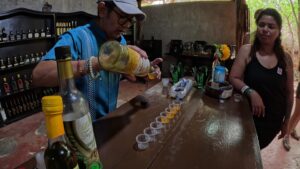
After the welcome ceremony, we enjoyed a tasting of artisanal tequila and traditional regional liqueurs.
The experience felt authentic and thoughtfully designed for small groups seeking a deeper cultural connection rather than a large commercial environment.
One of the aspects that stood out was the layout of the dining areas. Instead of a single large restaurant, the spaces are divided into smaller palapa-covered sections, each with its own service area and relaxed atmosphere.
This arrangement allows guests to enjoy regional flavors in a more personal and comfortable setting, highlighting the culinary identity of the Yucatán.
Walking Through the Jungle to Yun Chen Cenote
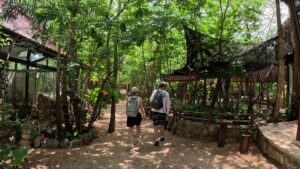
After the cultural activities, we walked along a shaded path surrounded by trees native to the Maya jungle. The short walk itself felt immersive and peaceful.
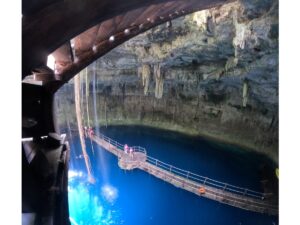
At the end of the path, Yun Chen cenote revealed itself as a beautiful natural freshwater formation surrounded by rock walls and vegetation.
Cenotes were considered sacred by the Maya civilization because they represented an essential water source in a region without rivers.
Sunlight entered from above, creating reflections on the water that enhanced the feeling of tranquility.
Swimming in this environment felt refreshing and memorable, offering a moment of connection with nature that complements the historical dimension of the day.
Suggested interlink anchor:
cenote swimming experience in Yucatán
Guided Visit to Chichen Itza
After the cenote visit, we continued toward Chichen Itza, one of the most recognized archaeological sites in the world and a UNESCO World Heritage Site.
The visit was well paced, allowing enough time to understand the significance of the structures without feeling rushed.
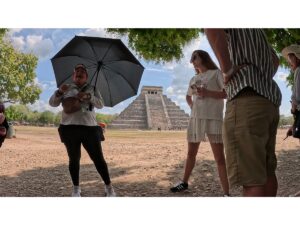
At the base of El Castillo pyramid, Gaby demonstrated how clapping at a certain rhythm creates an echo similar to the sound of the quetzal bird, a sacred symbol in Mesoamerican culture.
This acoustic phenomenon reflects the sophisticated architectural knowledge achieved by the Maya civilization.
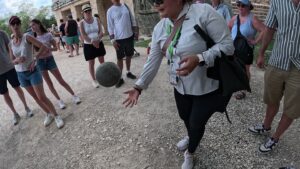
Near the Great Ball Court, we also had the opportunity to observe a faithful reproduction of the original rubber ball used in the ancient Maya ball game. Being able to see and touch the material helped illustrate the ceremonial importance of this sport.
Before finishing the guided portion, Gaby shared creative tips for taking perspective photographs that play visually with the scale of the pyramid.
This added a light and enjoyable moment to the visit, especially for couples and families.
Chichen Itza guided tours from Cancun
Discovering Valladolid Colonial Town
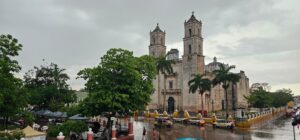
Our final stop was Valladolid, a colonial town known for its colorful architecture and relaxed atmosphere.
Walking through the central plaza offered a glimpse into daily life in the Yucatán, where cultural heritage and local traditions remain present.
The visit provided a calm and pleasant way to conclude the day before returning to Cancun.
Valladolid cultural visits
Overall Experience
What made this experience memorable was the balance between cultural learning, comfort, and thoughtful organization.
Each location complemented the next, creating a natural flow between archaeology, nature, gastronomy, and local traditions.
Gaby’s knowledge and enthusiasm made the journey especially engaging, helping transform historical information into something easy to understand and enjoyable to experience.
For travelers seeking more than a typical sightseeing tour, this itinerary offers meaningful insight into the traditions, symbolism, and living culture of the Maya world.